
Tempered Glass in Doors: What It Is and Why It’s Required
Short answer: yes, and it is almost always required by code. The glass set into your doors, and the glass right beside them, sits exactly where people trip, stumble, and throw out a hand to catch themselves. So building code treats those spots as hazardous locations and requires safety glass, which in most doors means tempered glass.
We field this question a lot from homeowners shopping for new doors in Apex, where newer construction means plenty of glass front doors, sidelights, and patio doors. Here is the plain version of what tempered glass is and where the rule applies.
What is tempered glass?
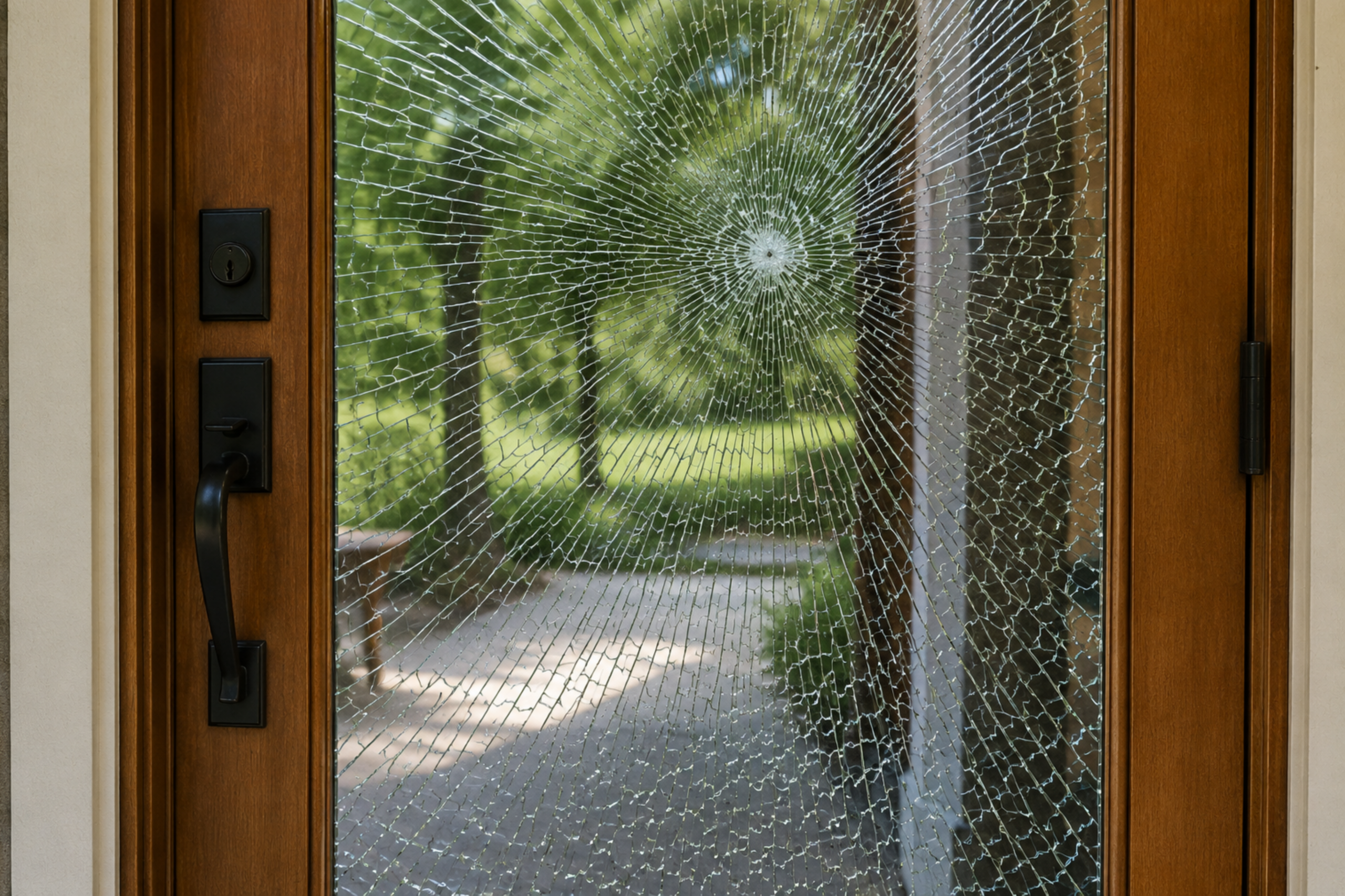
Tempered glass is heat-treated safety glass. It is made by heating ordinary glass to around 1,100 degrees, then cooling it fast with jets of air. That locks the surface in compression and the core in tension, which makes it roughly four to five times stronger than regular glass. The bigger deal is how it breaks. Instead of long, sharp shards, it crumbles into small, blunt pebbles that are far less likely to cut you. One catch worth knowing: tempered glass has to be cut to size before it is tempered, because it cannot be cut or drilled afterward without shattering.
Why is tempered glass required in doors?
Two reasons, and they are linked. The first is plain safety. A door is exactly where a person is most likely to walk into, fall against, or push a hand through the glass. This is especially true for children. Tempered glass turns what could be a trip to the ER into a pile of harmless pebbles. The second is code. Because doors are high-impact spots, building code requires safety glass there, and tempered is the usual way to meet that requirement.
Where is safety glass required in and around doors?
- In the door itself. Any glass in a swinging, sliding, or bifold door must be safety glass. That covers glass front doors and sliding and hinged patio doors.
- Beside the door. Glass next to a door, like a sidelight, must be safety glass when its bottom edge is less than 60 inches off the floor and it sits within a 24-inch arc of the door’s edge.
That 24-inch rule is easier to picture with a piece of string. Tie a 24-inch string to the edge of the door frame and swing it in an arc. Any glass it can reach that also sits lower than 60 inches off the floor needs to be safety glass.
Do sidelights and transoms need tempered glass?
Usually yes for sidelights, usually no for transoms, and that same 60-inch line is why.
A sidelight is the tall, narrow glass panel beside a door. It runs from low on the wall up alongside the door, so its bottom edge sits well under 60 inches and it falls right inside that 24-inch arc. That puts it squarely in a hazardous location, so a sidelight almost always has to be tempered.
A transom is the fixed window that sits above a door or above a sidelight. Because it is installed up high, its bottom edge is normally well above 60 inches off the floor, which puts it outside the hazardous zone. So a standard transom usually does not require safety glass. The exception is a combined sidelight/transom design where the glass extends from below that 60-inch line to above the door. If your entry transom has any similar configuration, it is worth confirming.
How can I tell if my door glass is tempered?
Look in a corner of the pane for a small permanent stamp, sometimes called the bug. Code requires tempered safety glass to carry a designation etched or fired right into the glass, naming the maker and the safety standard it meets, so you will see something like “CPSC 16 CFR 1201” or “ANSI Z97.1.” It is usually tucked into a bottom corner. If you cannot find one on glass that sits in or beside a door, that is worth asking about.
Tempered or laminated: which does my door need?
Both are safety glass, and they solve different problems.
- Tempered is the standard for doors. It is strong, and it breaks into harmless pebbles. It is what most door glass uses to meet code.
- Laminated is two panes bonded to a clear plastic interlayer. When it breaks, the pieces stick to the plastic and the pane holds together in the frame. That makes it better for security, sound, and UV, and it is what you want for impact-rated or hurricane-rated openings.
For a typical Apex home, tempered meets the safety requirement. If security, street noise, or storm protection is a priority, laminated, or a tempered-and-laminated combination, is worth asking about.
What about decorative glass?
Code carves out a narrow exception for true decorative glass, the carved or leaded art glass you see in some entry doors. In practice, reputable door makers still build those panels to hold up safely, and the decorative glass is usually sealed inside an insulated unit alongside safety glass. If you are choosing a decorative entry, just ask how the glass is built. You should not have to trade a beautiful door for a safe one.
The bottom line for your entry
If you are putting in a new front door, a patio door, or sidelights around Apex, the safety glass is not the place to cut corners, and with any reputable door it is handled for you. If you want to see the options and understand exactly what glass is going where, schedule a visit using the calendar below. No pressure, just straight answers.