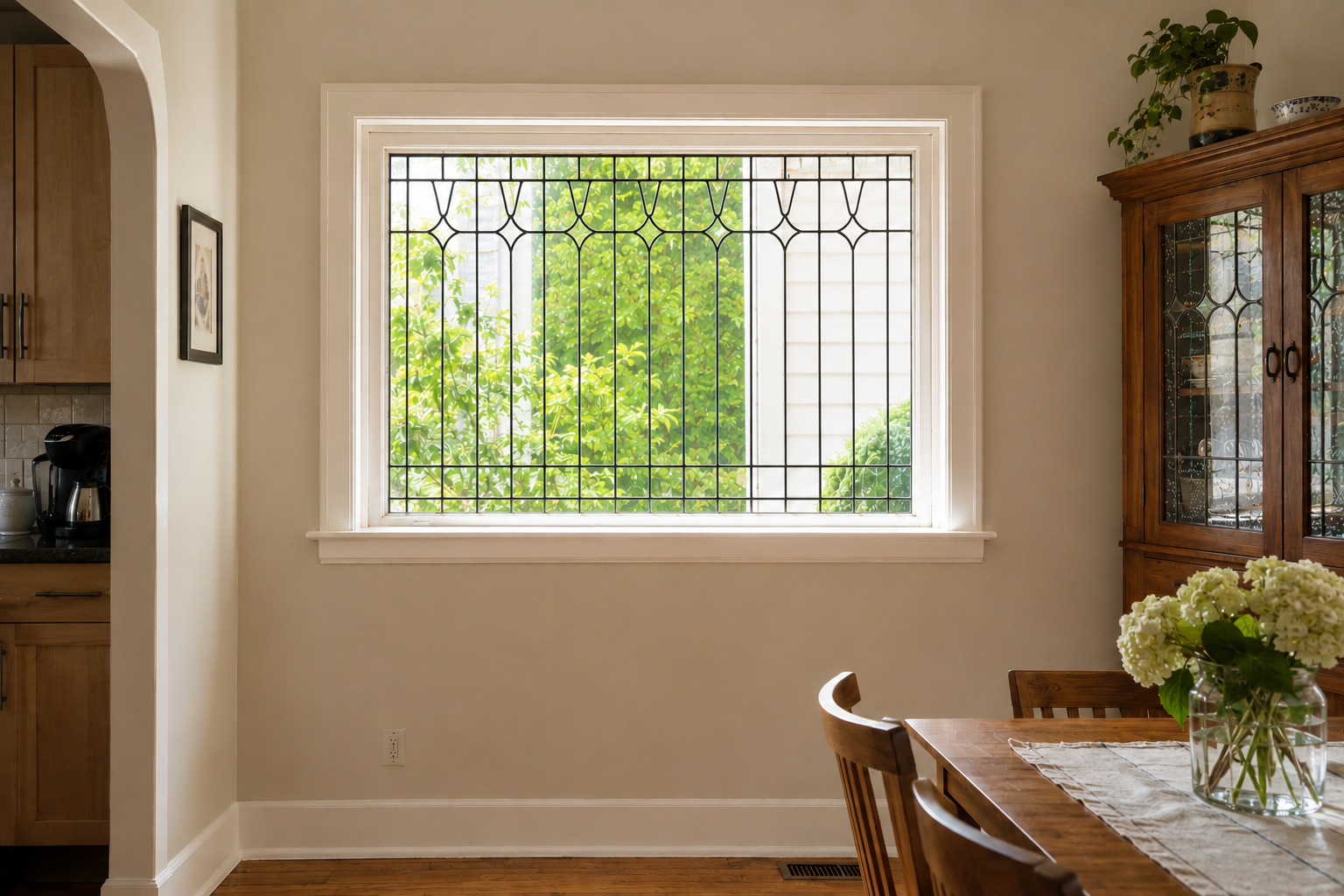
What Is Caming on a Window?
When you order a window with decorative glass, one of the choices you will be asked about is the caming. If your first thought is “the what?”, you are in good company. Most homeowners who visit our Cary window showroom have seen caming a hundred times without ever knowing it had a name.
Short answer: caming is the metal framework that holds the small pieces of glass together in a decorative or leaded glass design. It is the metal, not the glass. Each strip is called came, and the finished web of metal is the caming.

What is caming on a window?
Caming is the network of metal strips that separates and joins the individual pieces of glass in a decorative panel. Picture an old stained glass window. Those dark lines running between every piece are not painted on. They are metal channels, and the cut edges of the glass sit down inside them. That metalwork is the caming. Without it, you would just have loose pieces of glass and nothing holding the picture together.
Where does the word “caming” come from?
It comes from a very old craft. Medieval glassworkers were joining stained glass with slender, grooved strips of metal centuries before modern windows existed, and the word came has been around about as long. So when you pick a caming style today, you are choosing a detail with a thousand-year pedigree. That is part of why it reads as timeless rather than trendy.
What is caming made of?
Four metals do most of the work, and each has its own personality.
- Lead. Soft and easy to bend, so it handles curves and intricate designs. It ages to a soft blue-gray. Because it is soft, large lead panels can sag over the years.
- Zinc. Rigid, strong, and light. Good for straight lines, borders, and heavier beveled glass that would make lead sag.
- Brass. A warm, golden tone, often chosen for a traditional or formal look.
- Copper. A reddish, warm hue. Less common, used for a particular vintage feel.
The right metal depends on the design. Curvy, delicate patterns lean on lead. Big, straight, or heavy panels lean on zinc.
H-came and U-came: the two shapes
Two basic profiles do the joining. H-shaped came has a channel on each side, so it grips two pieces of glass at once, and it lives on the inside of the panel. U-shaped came has a single channel and runs around the outside edge as the border. That is the whole grammar of it. H on the inside, U on the rim.
Where do you see caming today?
You will find it in accent and specialty-shape windows and in transoms, the fixed window that sits above a door. It is also common in entry door glass and the tall narrow sidelights beside a door. In Cary, where a lot of homes lean traditional or transitional, a caming pattern in a feature window or transom is a common way to add character without giving up the light.
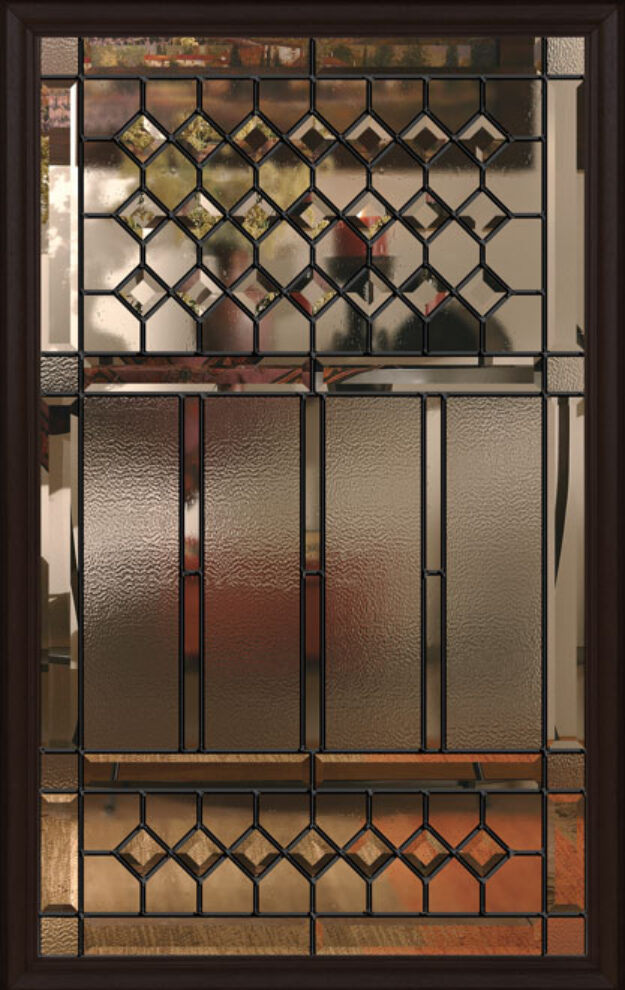
Caming can also be used to intersperse privacy glass into a larger window, like in the ProVia Carrington window pictured below. The effect is less stark than a whole window of privacy glass, while still obscuring the view enough to create privacy.
What caming finishes can I choose?
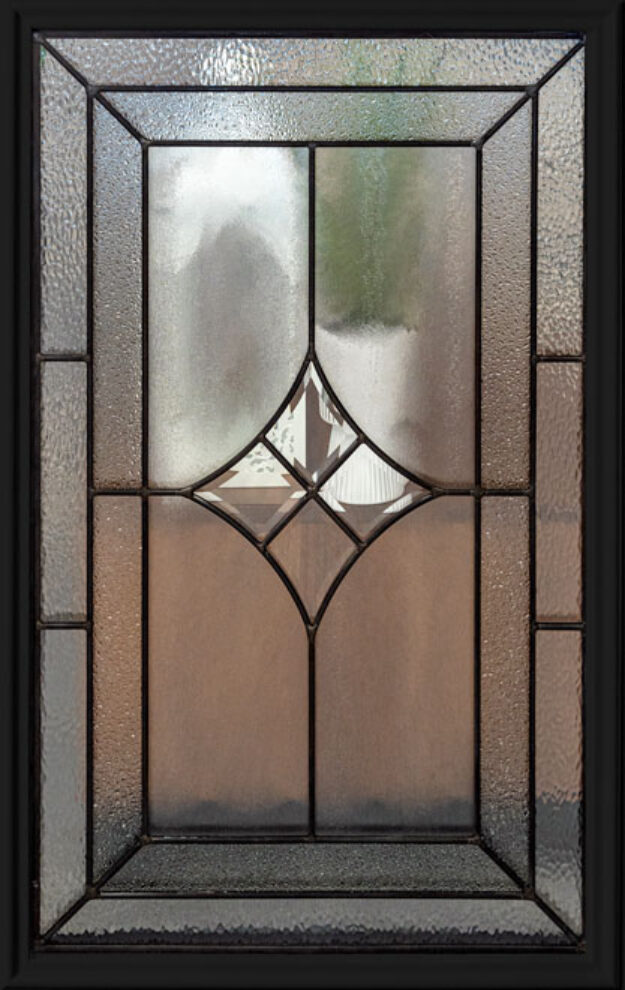
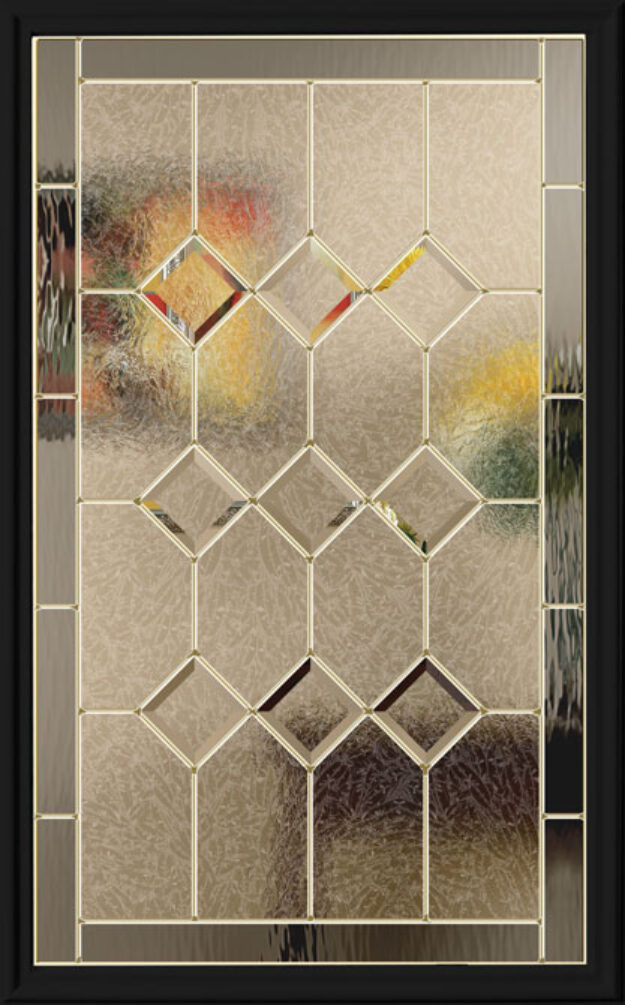
On today’s windows, the caming finish is a style decision. The common options are patina (a dark, near-black tone that reads like wrought iron), brass or gold (warm and traditional), nickel or pewter (a cooler silver tone), and zinc (clean and neutral). The same glass pattern can look formal in brass or rustic in patina, so the finish does a lot of the styling work on its own.
Below you can see the differences between darker, patina finish caming and brighter, zinc finish caming
Is decorative caming drafty or inefficient?
This is the worry we hear most, and for modern windows the answer is no. Antique stained glass was a single layer, and yes, it could be drafty. Today’s decorative glass is built differently. The caming and glass pattern are almost always sealed between two panes of clear glass, like a decorative filling inside an insulated sandwich. That protects the design, makes the surface easy to clean, and lets the whole unit be Low-E. So you get the look of leaded glass with the energy performance of a modern insulated window.
A detail worth getting right
Caming is one of those small things that quietly sets the character of a feature window or an entry. A little goes a long way. If you are weighing decorative glass for an accent window, a transom, or an entry, we are glad to walk you through the glass patterns and caming finishes and show you what suits your home. No pressure, just options and honest guidance. If you would like to see them in person, schedule a visit using the calendar below.